LC739: Daily Temperatures
Mediummonotonic stack
The brute force works, but at 100,000 days it is about 5 billion comparisons. A stack of the days still waiting does it in O(n).
The problem
Given a list of daily temperatures, return how many days you wait after each day for a warmer one, or 0 if no warmer day comes. For [73,74,75,71,69,72,76,73] the answer is [1,1,4,2,1,1,0,0].
See it
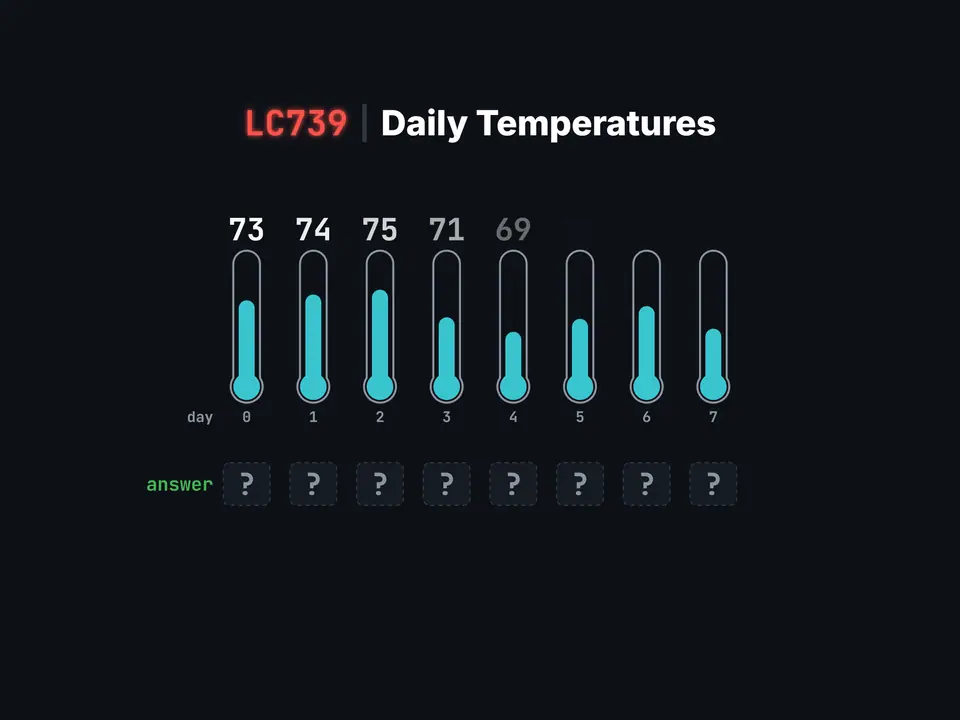
Example 1 as thermometers, one per day. Every answer starts unknown. ![The finished answer, [1,1,4,2,1,1,0,0]: days 6 and 7 never see a warmer day, so they stay 0.](/problems/739/02_s02_answer_row_filled-960.webp)
The finished answer, [1,1,4,2,1,1,0,0]: days 6 and 7 never see a warmer day, so they stay 0. 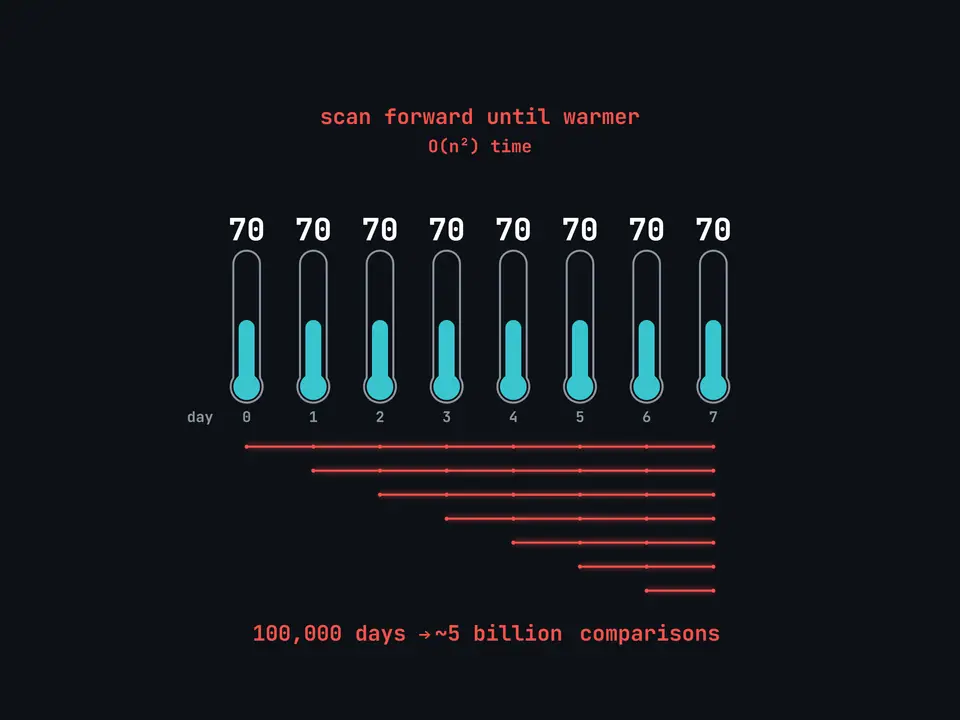
Brute force scans forward from every day. Flat temperatures are its worst case: about 5 billion comparisons at 100,000 days. 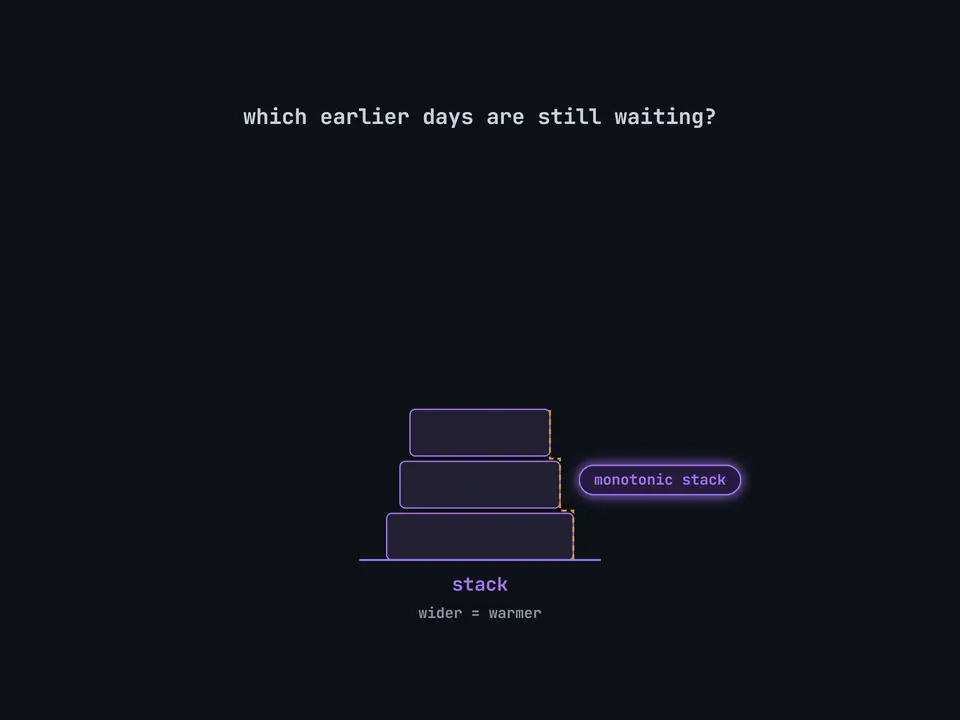
The days still waiting form a stack that never gets warmer toward the top, a monotonic stack. 
Day 5 (72) checks the top of the stack, where 75, 71 and 69 are still waiting. 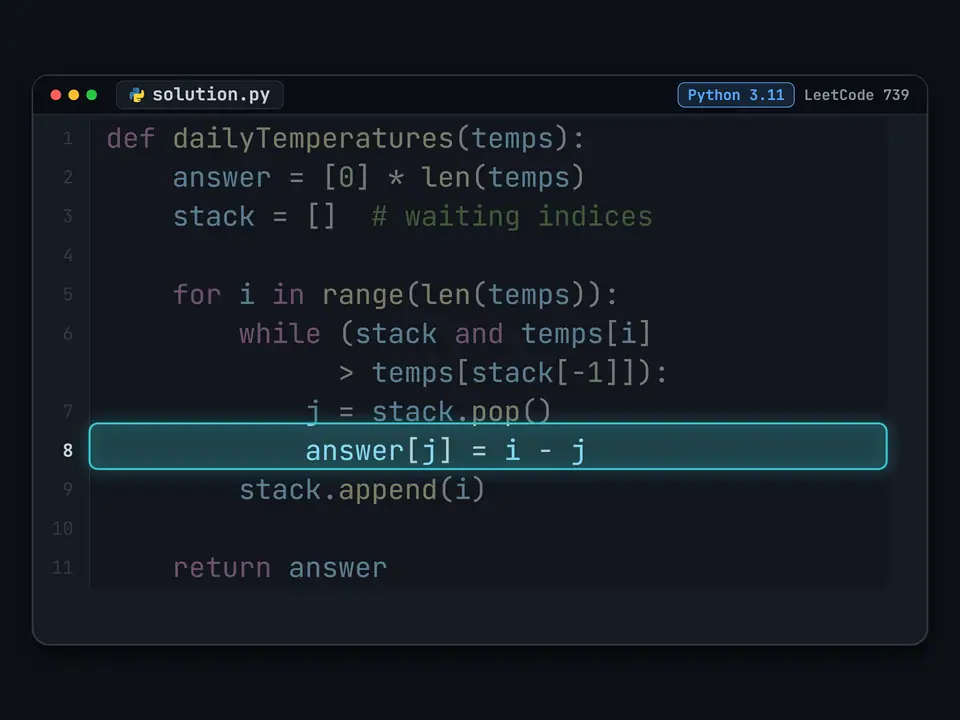
The stack solution from the video, the same code as below. 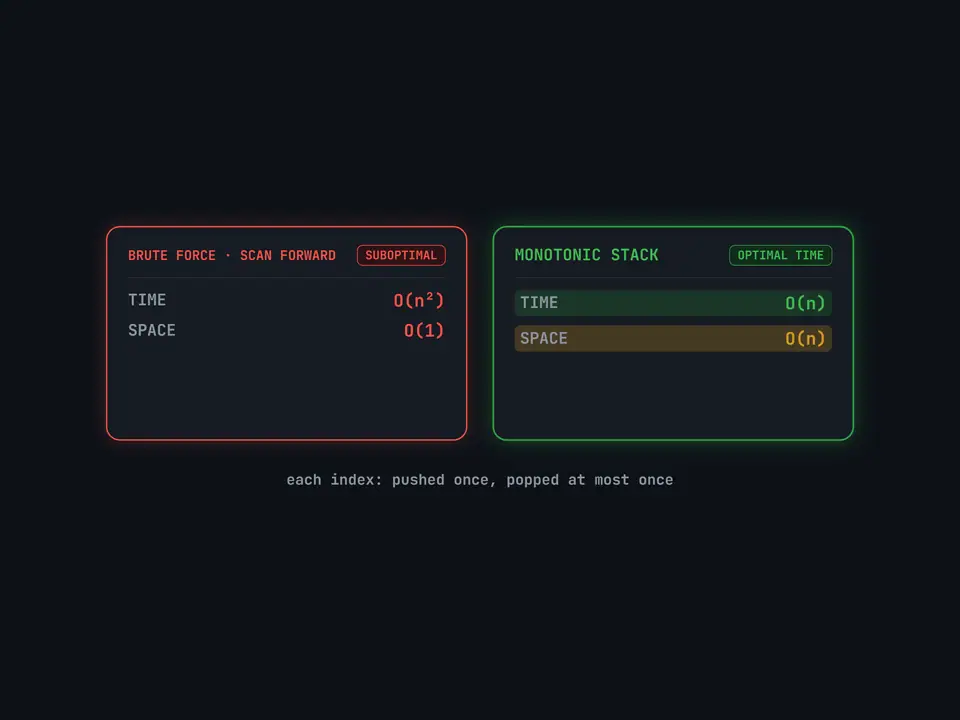
The trade: brute force is O(n²) time and O(1) space; the stack is O(n) time and O(n) space.

![The finished answer, [1,1,4,2,1,1,0,0]: days 6 and 7 never see a warmer day, so they stay 0.](/problems/739/02_s02_answer_row_filled-1440.avif)


The code
1def dailyTemperatures(temps):2 answer = [0] * len(temps)3 stack = [] # waiting indices4 5 for i in range(len(temps)):6 while (stack and temps[i]7 > temps[stack[-1]]):8 j = stack.pop()9 answer[j] = i - j10 stack.append(i)11 12 return answerThe stack holds indices, not temperatures: when today i is warmer than waiting day j, the answer for j is i - j. The comparison is strict (>), so an equal day is not a warmer one.
Complexity
- Time: O(n). Each index is pushed once and popped at most once.
- Space: O(n) extra. The stack grows while temperatures never go up; with all-equal days it holds every index.
- Brute force: O(n²) time in the worst case, about 5 billion comparisons at 100,000 days. On the 8-day example the two are nearly tied, 11 comparisons to 10; the gap only shows at scale.
Edge cases
- All equal:
[70,70,70,70]gives[0,0,0,0], because equal is not warmer. - Equal, then warmer:
[70,70,71]gives[2,1,0]. - A single day has no later day, so its answer is
[0]. - Temperatures that never rise give all zeros, and they fill the stack: its worst case for space.
Where you'd actually use this
Mostly in interviews. Daily Temperatures is asked at companies like Amazon and Google (source: Educative) because the obvious scan works but is O(n²), and getting to O(n) takes a new idea: keep a stack of the days still waiting for a warmer one.
Early access
Join Cohort 0
The first group to try the full site before anyone else. We start with algorithms and data structures, then go further into computer science.
- Run your own code and watch every step
- See the exact step where your logic breaks
- Vote on what we animate next
- Get the private link before public launch